
You’ve spent the last seven years building your company. You’ve survived the “ramen profitable” stage, managed infrastructure debt, and scaled your ARR to a point where the big players are finally knocking on your door.
Then comes the Letter of Intent (LOI). It looks beautiful. The headline number is exactly what you wanted, let’s say $20 million. But as you read the fine print, you see the breakdown: $12 million in cash at closing, and $8 million tied to an “earnout” over the next three years.
In your head, you’re already spending that $20 million. In reality, that $8 million is a just a dream.
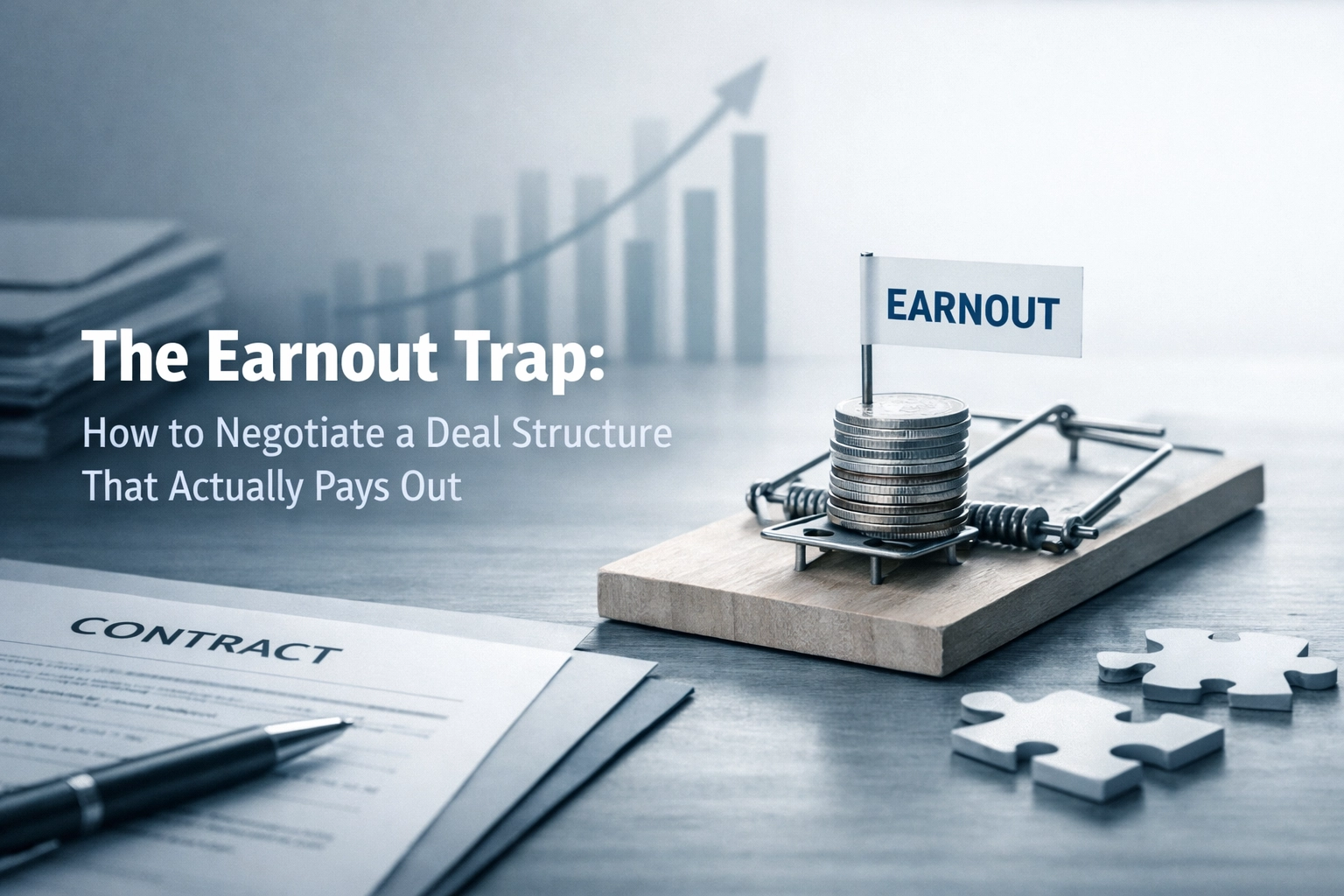
I have seen too many brilliant founders fall into the “Earnout Trap.” They trade their freedom and their equity for a promise that, more often than not, never materializes. If you aren’t careful with your deal structure, you won’t just lose the money, you’ll spend the next three years as a “corporate zombie,” working for a boss who has every financial incentive to make sure you never see a dime of that contingent payment.
What is an Earnout (And Why Do Buyers Love Them?)
An earnout is a deal structure in a business sale where a portion of the purchase price is deferred and paid out only if the business hits specific performance targets after the sale.
To a buyer, an earnout is a risk-mitigation tool. If they are worried about your churn rate or whether your growth is sustainable without you there, they push that risk onto you. If the company performs, they pay. If it doesn’t, they got your business at a massive discount.
To a founder, however, an earnout is often a gamble where the buyer holds all the cards. Once the deal closes, you no longer own the company. You no longer control the budget, the marketing spend, or the product roadmap. Yet, your “bonus” depends entirely on the outcome of those variables.
The Three Pillars of the Earnout Trap
Why do most earnouts fail to pay out? It usually comes down to three specific traps that buyers set, sometimes intentionally, sometimes through sheer corporate bureaucracy.
1. The Accounting Shell Game
This is the most common way founders lose their earnout. Most buyers want to tie earnouts to EBITDA (Earnings Before Interest, Taxes, Depreciation, and Amortization) or Net Income.
Here is the problem: Once the buyer takes over, they can load your company with corporate overhead. They might decide your small team needs to move into their expensive downtown office. They might “allocate” a portion of the parent company’s legal, HR, and marketing costs to your P&L. Suddenly, even if your revenue is skyrocketing, your “profit” vanishes under the weight of corporate expenses.
2. The Integration Sabotage
In the SaaS world, buyers often purchase a company to integrate the technology into their existing suite. During this “integration” phase, the focus shifts from selling your product to migrating users or refactoring code.
If your earnout is tied to the sales growth of your specific product, but the buyer’s sales team is instructed to focus on the “all-in-one” platform, your numbers will crater. You’re left holding the bag while the buyer enjoys the long-term value of your IP.
3. The “Corporate Zombie” Syndrome
This is the emotional trap. You go from being the visionary CEO to a middle manager. You want to hire a new developer to fix a bug; the buyer says it’s not in the budget. You want to pivot the marketing strategy; the buyer’s VP of Marketing says no.
Eventually, founders get “burned out on the earnout.” They realize that the stress of fighting for a payout they no longer control isn’t worth it. They leave early, forfeiting the money just to get their sanity back.
How to Negotiate a Deal Structure That Actually Works
If an earnout is unavoidable, you need to move from a position of “hope” to a position of “protection.” I help founders negotiate the specific deal structure business sale terms that keep the buyer honest.
Focus on Top-Line Metrics, Not Bottom-Line
The golden rule of earnouts: Never tie your payout to profit.
Profit (EBITDA) is too easy to manipulate. Instead, tie the earnout to Revenue or Gross Profit. Revenue is much harder to hide. If the product is being sold, the revenue is hitting the books. It’s a clean metric that is easy to audit and difficult for a buyer to “account” away.
Demand “Negative Covenants”
You need legal protections that prevent the buyer from making decisions that intentionally tank your earnout. These are called negative covenants. They might include:
- A requirement that the buyer maintains a certain level of marketing spend for your product.
- A restriction on the buyer “allocating” corporate overhead to your P&L.
- A guarantee that you retain control over key hiring and firing decisions for your team during the earnout period.
Shorten the Timeframe
A three-year earnout is an eternity in the software world. Technologies change, markets shift, and corporate priorities rotate every six months. Aim for an earnout of 12 months. If the buyer insists on longer, the “upfront” cash portion of the deal needs to be significantly higher to compensate for the increased risk.
The “Buy-Out” Clause
What happens if the buyer decides to sell the whole company six months after buying yours? Or what if they fire you without cause? Your contract should include an “acceleration” clause. If the buyer changes the game or terminates your employment without a very specific (and narrow) “for cause” reason, the entire earnout should become due and payable immediately.
When Should You Walk Away?
There are times when the earnout structure is so lopsided that the deal is effectively a lie. If the upfront cash doesn’t meet your “walk-away” number: the amount you need to feel like the last few years of your life were worth it: then the deal isn’t ready.
You should never count on earnout money to make a deal “good.” An earnout should be the “cherry on top” of an already solid valuation. If you find yourself staying awake at night wondering if you can hit a target that requires the buyer’s permission, you are in the trap.
How We Help You Secure the Exit You Deserve
Negotiating a business sale is an emotional and technical minefield. Buyers do this for a living; you likely only do it once or twice in a lifetime. They have a team of M&A lawyers and accountants designed to minimize their risk: often at your expense.
I act as the shield for the founder. We don’t just look at the headline price; we look at the earnout structure and the tax implications to ensure that what you see on the LOI is what actually ends up in your bank account.
We understand the software industry. We know how IP is valued and how easily it can be buried inside a larger corporation. Our goal is to make sure you exit your business with your wealth: and your sanity intact.